
Abstract
For workers who spend long hours standing in retail stores, production lines, or commercial kitchens, proper underfoot support plays a critical role in reducing fatigue, improving comfort, and maintaining workplace efficiency. Choosing the right mat solution can directly impact employee well-being, productivity, and long-term operational costs.
A standing massage foot mat provides more than basic cushioning. With raised massage points, multi-layer shock absorption, and durable material options, it helps improve pressure distribution and support better standing comfort compared with traditional flat mats. However, many procurement teams still need to evaluate whether its performance advantages justify the additional investment.
This article compares standing massage foot mats and regular mats from four key perspectives: ergonomic design, fatigue reduction performance, material selection, compliance requirements, and commercial value, helping businesses make informed sourcing decisions for different workplace environments.
Design Engineering — What Makes a Standing Massage Foot Mat Different?
Raised Massage Points & Ergonomic Surface Design
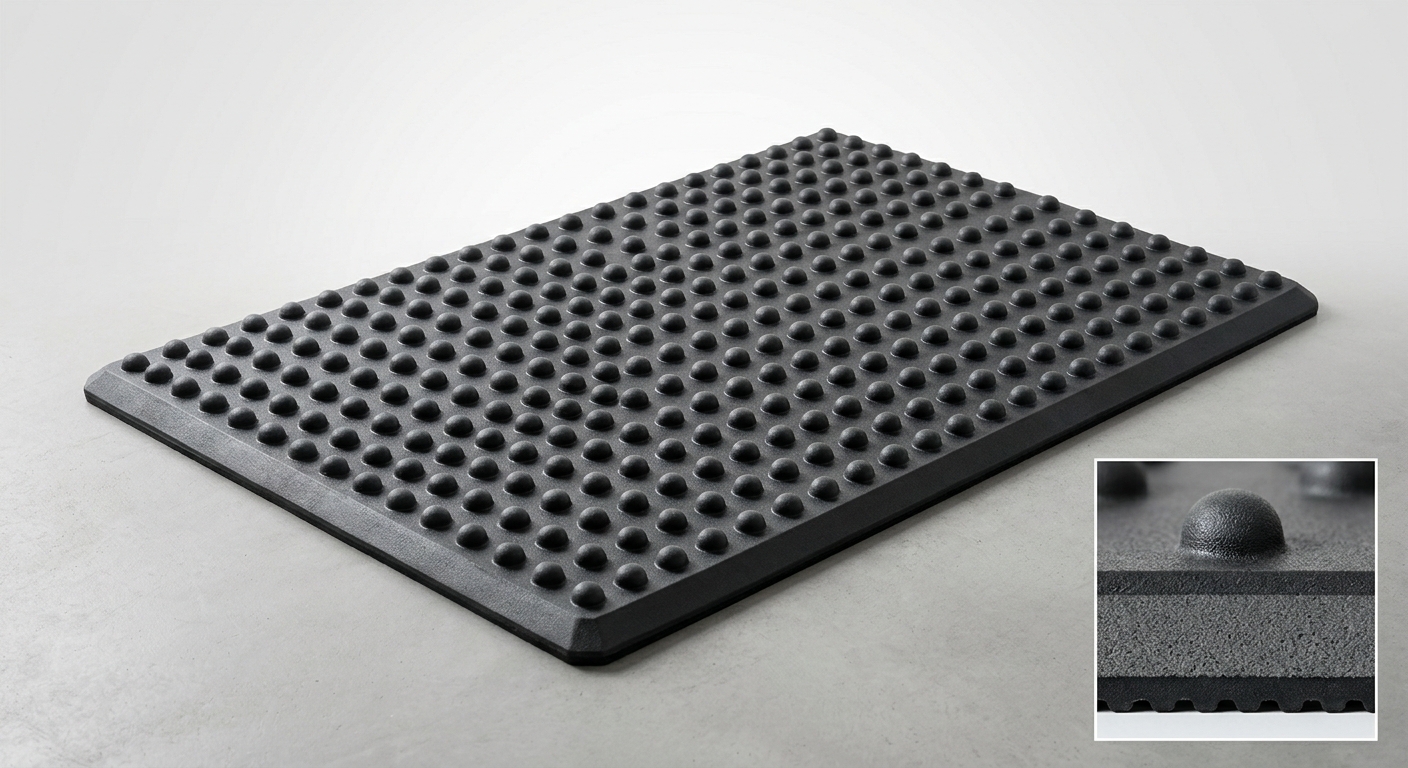
The key design advantage of a standing massage foot mat is its raised massage point surface, which provides more than basic cushioning. These strategically positioned massage nodes, typically ranging from 5 mm to 12 mm in height, create targeted contact points that help stimulate the plantar area while users naturally shift their weight during standing.
This ergonomic surface design helps address two major causes of standing fatigue: uneven pressure distribution and prolonged static loading. By creating small variations in foot contact areas, raised massage points encourage natural movement and reduce continuous pressure on specific areas such as the heel and forefoot. This can help improve standing comfort during extended work shifts.
In addition, many professional standing massage foot mats feature beveled edges with gradual slopes to improve workplace safety and prevent tripping hazards. Compared with flat mats that mainly provide passive cushioning, massage mats introduce an active surface structure that supports better pressure management and overall ergonomic performance.
Multi-Layer Shock Absorption vs. Traditional Flat Mat Construction
A high-quality standing massage foot mat typically uses a multi-layer construction designed to balance comfort, durability, and support. A common structure includes:
- Top massage layer: Textured TPE or PVC surface with raised massage points for ergonomic stimulation
- Middle cushioning layer: High-density NBR foam or EVA core to absorb impact and maintain compression recovery
- Anti-slip base layer: Rubber backing with ribbed or suction patterns to improve floor stability
Compared with traditional flat mats that often rely on a single foam or rubber layer, multi-layer massage mats provide better long-term resilience under continuous workplace use. Basic mats may gradually lose thickness and cushioning performance due to repeated compression, while a well-designed standing massage foot mat maintains more consistent support throughout its service life.
| Parameter | Standing Massage Foot Mat | Regular Flat Mat |
|---|---|---|
| Surface texture | Raised massage point array | Flat or minimally textured |
| Massage point height | 5–12 mm | N/A |
| Material layers | 3-layer (TPE/foam/rubber) | 1–2 layers (foam or rubber) |
| Compression resilience | 45–65% | 20–35% |
| Anti-fatigue rating | High | Low to medium |
| Recommended standing duration | Up to 10+ hours | Up to 4–6 hours |
| Available thickness | 15–25 mm | 8–15 mm |
| Certifications | CE, RoHS, REACH, SGS | Varies |
| Price tier (B2B unit) | Mid to premium | Entry to mid |
Standing Massage Foot Mat vs Anti Fatigue Mat: What Is the Difference?
Although both standing massage foot mats and anti fatigue mats are designed to improve workplace comfort, they focus on different aspects of ergonomic support.
Traditional anti fatigue mats mainly reduce impact by providing a softer surface between the feet and hard flooring. Their primary function is passive cushioning, which helps reduce pressure caused by prolonged standing.
A standing massage foot mat provides an additional level of ergonomic support through active surface stimulation. The raised massage points encourage natural weight shifting, improve pressure distribution, and reduce static loading on specific areas of the foot.
| Feature | Standing Massage Foot Mat | Traditional Anti Fatigue Mat |
|---|---|---|
| Main function | Active stimulation + cushioning | Passive impact reduction |
| Surface design | Raised massage points | Flat foam or rubber surface |
| Pressure distribution | Dynamic adjustment | Basic cushioning |
| Long standing suitability | 8+ hour shifts | Short to medium standing periods |
| Best applications | Retail, kitchens, factories | General workplaces |
For workplaces where employees stand for extended shifts, choosing between the two depends on workload duration, floor conditions, and ergonomic requirements. A standing massage foot mat is often preferred when fatigue reduction and long-term employee comfort are key priorities.
Performance & Health Impact — Reducing Foot Fatigue During Long Standing Hours
Biomechanical Benefits of Massage Stimulation on Fatigue Reduction
Ergonomic research consistently identifies plantar pressure concentration and restricted microcirculation as the two primary physiological drivers of standing fatigue. A standing massage foot mat addresses both simultaneously.
Raised massage points create continuous proprioceptive feedback that encourages subtle postural micro-adjustments — shifting weight between the heel, midfoot, and forefoot rather than locking into a static stance. This dynamic engagement activates the calf muscle pump, which is essential for venous return from the lower extremities. Studies in occupational ergonomics have linked active surface stimulation to statistically significant reductions in lower limb discomfort scores after 4-hour standing intervals compared to flat mat controls.
Additionally, the higher compression resilience of multi-layer massage mats maintains consistent energy return throughout a full work shift. Workers report measurably lower fatigue onset and reduced lower back strain — a secondary benefit driven by improved ankle and knee alignment that the raised surface geometry supports.
Regular Mat Limitations in High-Duration Standing Environments
Regular flat mats perform adequately for standing durations under 4 hours and in light-duty environments. Their limitations become operationally significant in high-duration deployments:
- Compression set degradation: Single-layer foam mats lose 30–50% of their original thickness resilience within the first year of daily use, progressively reducing their anti-fatigue benefit
- No active stimulation: Without surface topology variation, flat mats cannot promote circulation or prevent static pressure concentration
- Fatigue onset gap: In comparative workplace assessments, workers on flat mats report measurable fatigue onset approximately 90 minutes earlier than those on massage-point mats during 8-hour shifts
- Higher replacement frequency: Compression set failure means flat mats require replacement every 12–18 months versus 3–5 years for quality massage mats — a critical total cost consideration
Material Specifications & Compliance Standards
Core Materials — PVC, TPE, NBR Foam & Anti-Slip Base Options
Material selection in a standing massage foot mat determines not only durability but also environmental suitability and regulatory compliance. The three primary material systems are:
TPE (Thermoplastic Elastomer): The premium choice for top-layer construction. TPE is latex-free, odorless, and recyclable. It maintains surface integrity across a wide temperature range (-20°C to +60°C) and is suitable for food-grade environments when formulated without restricted plasticizers.
PVC (Polyvinyl Chloride): Cost-effective and highly durable for industrial applications. Procurement teams should verify REACH compliance (SVHCs below 0.1% w/w) and confirm phthalate-free formulations for sensitive environments.
NBR Foam (Nitrile Butadiene Rubber): Preferred for mid-layer cores in environments with oil or chemical exposure. NBR foam delivers superior compression resilience and chemical resistance versus standard EVA foam alternatives.
Anti-slip rubber base: Vulcanized natural or synthetic rubber bases with ribbed or suction-cup patterns provide floor adhesion ratings suitable for both dry and wet zone deployment.
Industry Certifications & Regulatory Considerations for B2B Buyers
Before finalizing supplier selection, procurement teams should verify the following compliance documentation:
- CE Marking: Confirms product meets EU safety, health, and environmental protection standards
- RoHS Compliance: Restricts hazardous substances in electrical/electronic equipment contexts; relevant for ESD-rated mat variants
- REACH Certification: Chemical substance compliance for EU market entry
- SGS Test Reports: Independent third-party material and performance verification
- OSHA Ergonomic Guidelines: US buyers should confirm mat specifications align with OSHA’s general industry standing workstation recommendations
For food and beverage environments, additionally request FDA-compliant material declarations or equivalent national food-contact certifications.
How to Choose a Standing Massage Foot Mat for Different Work Environments
Different workplaces create different challenges for standing comfort. The ideal standing massage foot mat should be selected based on factors such as standing duration, floor conditions, cleaning requirements, and employee workload.
Retail and Checkout Areas
Retail employees often stand on hard floors for extended periods while maintaining frequent customer interaction. A mat with balanced cushioning, slip resistance, and an attractive surface design can improve comfort without affecting workplace appearance.
Recommended features:
- 15–20 mm thickness for daily standing support
- Easy-clean surface material
- Beveled edges to reduce trip risks
- Custom colors for brand consistency
Commercial Kitchens and Food Processing Areas
Kitchen environments require mats that can handle moisture, grease, and frequent cleaning. Material selection becomes especially important because poor-quality foam may absorb liquids or degrade under chemical exposure.
Recommended features:
- Waterproof PVC or TPE surface
- Anti-slip base structure
- Easy sanitation capability
- Chemical-resistant materials
Manufacturing and Assembly Stations
Factory workers often remain in fixed positions for several hours while performing repetitive tasks. Durability and compression recovery are key considerations in these environments.
Recommended features:
- High-density foam core
- Strong load-bearing capability
- Long service life
- Optional ESD-safe versions for electronic assembly areas
Healthcare and Laboratory Environments
Healthcare and laboratory spaces require hygiene-focused solutions. The mat surface should support regular cleaning while maintaining slip resistance and comfort.
Recommended features:
- Non-porous materials
- Easy-to-clean surface
- Antimicrobial options
- Stable performance after repeated sanitization
Choosing the right standing massage foot mat based on workplace conditions helps maximize comfort, durability, and long-term return on investment.
Application Scenarios & Commercial Value
Industry-Specific Use Cases — Retail, F&B, Manufacturing & Healthcare
Different operational environments impose distinct requirements on mat performance and specification:
Retail & Checkout Stations: High foot traffic, 6–10 hour shifts, dry floors. Priority: comfort, aesthetics, beveled edge safety. Recommended: 18–20 mm TPE massage mat with branded color options.
Food & Beverage / Commercial Kitchens: Wet zones, grease exposure, hygiene protocols. Priority: fluid drainage, chemical resistance, easy sanitization. Recommended: PVC or NBR massage mat with drainage perforation patterns and food-grade certification.
Manufacturing & Assembly Lines: Heavy-load stations, potential ESD sensitivity, shift work. Priority: compression resilience under load, ESD-safe variants, durability. Recommended: 20–25 mm NBR foam core with ESD-dissipative surface layer.
Healthcare & Laboratory: Sterile environments, anti-microbial requirements. Priority: surface hygiene, non-porous materials, chemical cleaning compatibility. Recommended: TPE top-layer with anti-microbial additive and seamless construction.
Total Cost of Ownership — Bulk Sourcing, Durability & ROI for Procurement Teams
The procurement case for standing massage foot mats strengthens considerably when evaluated on total cost of ownership (TCO) rather than unit price alone:
| Cost Factor | Standing Massage Foot Mat | Regular Flat Mat |
|---|---|---|
| Average unit lifespan | 3–5 years | 12–18 months |
| Replacement cycle (5 years) | 1× | 3–4× |
| 5-year cost per station | Lower cumulative | Higher cumulative |
| Worker fatigue-related downtime | Measurably reduced | Higher incidence |
| Bulk MOQ (typical B2B) | 50–200 units | 100–500 units |
For a 100-station deployment, the replacement cycle difference alone can represent 200–300% more units purchased over five years with flat mats. When combined with measurable reductions in worker fatigue-related absenteeism and injury claims — which OSHA data links to inadequate standing support — the ROI case for massage mats is quantifiable and defensible to procurement stakeholders.
FAQ
Q1: What thickness is best for standing massage foot mats?
For workers standing over 8 hours daily, 20–25 mm thickness is generally recommended. This range provides better cushioning, pressure relief, and compression recovery for long-term workplace use.
Q2: Can standing massage foot mats be used in wet areas?
Yes. Choose PVC or TPE mats with anti-slip surfaces, water resistance, and proper safety certifications. These materials are suitable for kitchens, workshops, and other demanding environments.
Q3: What is the MOQ for custom standing massage foot mats?
MOQ varies by supplier and customization requirements. Standard orders may start from 50–200 units, while custom sizes, colors, and logos usually require higher quantities.
Q4: How long does a standing massage foot mat last?
A high-quality standing massage foot mat typically lasts 3–5 years depending on material quality, usage frequency, and maintenance. Regular cleaning and proper installation can extend service life.
Q5: Are standing massage foot mats suitable for factories?
Yes. They are suitable for factories, assembly lines, and workstations where employees stand for long periods. Durable materials and strong compression recovery help improve workplace comfort.
Q6: How do you clean a standing massage foot mat?
Most PVC and TPE mats can be cleaned with mild detergent and water. Avoid harsh chemicals or excessive heat to protect the surface texture and material performance.
Conclusion
A standing massage foot mat provides better ergonomic support than regular flat mats for workplaces where employees stand for extended periods. Its raised massage points help distribute pressure more evenly, while the multi-layer construction improves cushioning, durability, and long-term comfort.
For businesses evaluating workplace flooring solutions, choosing the right material, thickness, and design is essential to achieving better performance and value. We provide customizable standing massage foot mat solutions for different applications, including retail, kitchens, factories, and commercial workspaces. Contact us to discuss your project requirements and bulk sourcing needs.
