
Introduction
You sit in the driver’s seat, buckle up, and soon that familiar lower back ache returns. For millions of people, this is a daily reality. The average driver spends about one hour behind the wheel each day, while many commuters and professionals endure four to eight hours.
Most factory car seats simply don’t support the spine’s natural curve.
Memory foam lumbar support aims to solve this problem.
But does it actually work, or is it just another accessory that gets tossed in the trunk? Let’s examine what real experience and evidence show.
What Actually Happens to Your Back When You Drive
Before we talk about solutions, let’s talk about the problem.
When you sit in a car seat, your pelvis rotates backward. This flattens the natural inward curve of your lower spine—what doctors call lordosis. Your back muscles have to work overtime to hold your torso upright. Over time, this constant tension leads to fatigue, stiffness, and eventually chronic pain.
But the problem isn’t just about muscle tension. It’s also about pressure. Your weight concentrates on the tailbone and the ischial tuberosities—the bony prominences of your pelvis. That pressure restricts blood flow and irritates the surrounding nerves.
Harvard Medical School confirms what many drivers already know: sitting for long periods or in awkward positions puts pressure on your back. Their formal recommendation? “Use a lumbar pillow to support your lower back”. This is where a high-quality memory foam lumbar support comes into play.
But not all lumbar pillows are created equal. And that’s where memory foam enters the conversation.
Why Memory Foam? The Science of Support
Memory foam wasn’t invented for car seats. It was developed by NASA in the 1960s to improve crash protection for airplane pilots. The material was designed to absorb shock and distribute pressure evenly—properties that translate remarkably well to automotive comfort.
Viscoelastic Properties
Memory foam responds to heat and pressure. When you lean against it, the foam softens where your body makes contact and firms up everywhere else. This creates a customized support surface that conforms to your unique spinal curve. Unlike standard foam that pushes back uniformly, a memory foam lumbar support adapts to your specific shape.
Pressure Distribution
Instead of concentrating your weight on a few pressure points—like your tailbone or the bony prominences of your pelvis—memory foam spreads that force across a larger area. This improves blood circulation and reduces the discomfort that builds up over hours of driving. Independent testing has shown that memory foam can reduce peak pressure by up to 30% compared to traditional cushioning materials.
Vibration Dampening
This is a benefit most drivers don’t consider. Good-density memory foam acts as a damper for low-frequency road vibrations—typically in the 4-8 Hz range, which are known to resonate with the human spine and cause fatigue. Research from the University of Southampton found that lumbar support significantly affects vibration transmission through car seats, with clear resonance frequency changes when support is adjusted.
Slow Rebound
The “slow recovery” characteristic means the foam doesn’t push back immediately. It gives your body time to settle into a natural position, then provides firm support once you’re there. This dynamic response is what makes memory foam lumbar support so effective for prolonged sitting.
For drivers, this translates to something tangible: less fidgeting, less shifting, less fatigue. And over time, less chronic back pain.
The Lumbar Gap: What Car Seats Don’t Give You
Here’s a design flaw that most drivers don’t think about. Car seats are built for average body types—but “average” doesn’t exist. Everyone’s spinal curvature is slightly different. Everybody has a unique shape, weight distribution, and sitting posture.
The result is what ergonomists call the lumbar gap—the space between your lower back and the seat. Without support, your spine sags into this gap. Your muscles compensate. And over time, that compensation becomes chronic pain.
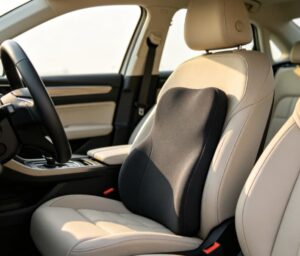
A memory foam lumbar support fills that gap. It provides targeted support to the lumbar region—the lower five vertebrae that bear the brunt of sitting stress. Filling the gap, it helps maintain proper spinal alignment and reduces the tension that builds up in your back muscles.
What radiological research reveals: A study published in Applied Ergonomics found that increasing lumbar support prominence from 0 cm to 4 cm increased lumbar lordosis angle from 20° to 30°—a significant improvement in spinal posture. The same study confirmed that lumbar supports impact vertebral rotations throughout the lumbar spine.
The result? You sit taller. You breathe easier. And you arrive at your destination without that familiar ache. A properly designed memory foam lumbar support effectively transforms an ordinary car seat into an ergonomic workspace.
The Different Types of Lumbar Support: Which One Works Best?
Not all lumbar supports are the same. Understanding the differences helps you make the right choice.
-
Wedge-Shaped Cushions
Wedge cushions are designed to tilt your pelvis forward, restoring the natural curve of your lower spine. These are often recommended by physical therapists because they address the root cause of sitting-related back pain—the backward rotation of the pelvis. A wedge-style memory foam lumbar support is particularly effective for drivers with significant lower back pain.
-
Rectangular Lumbar Rolls
These are cylindrical cushions that fit horizontally across the lower back. They provide concentrated pressure on the lumbar region. Some drivers find them effective; others find them uncomfortable because they create a concentrated pressure point rather than distributing support evenly.
-
Full-Back Contour Supports
These cover the entire backrest area. They offer the most comprehensive support, but they’re less portable than smaller cushions. They’re best for drivers who spend extended hours in a single vehicle.
-
Removable Pillow-Style Supports
Research published in the Work journal tested both integrated and removable lumbar-sacral supports. Real driving tests showed an improvement in comfort perception with removable supports compared to standard seats. Fifty participants rated their perceived comfort, and both subjective and objective data confirmed significant improvements.
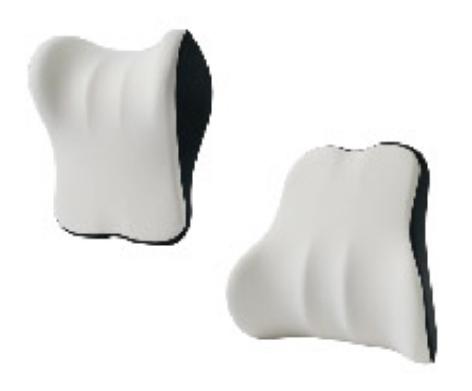
The Combination Lumbar Support product page describes a design that works across these categories—providing focused lumbar support while maintaining portability. This versatility is what makes a well-designed memory foam lumbar support suitable for multiple vehicles.
Memory Foam vs. Gel: Which One Wins for Cars?
This is the debate that keeps coming up in driver forums. And the answer depends on what you prioritize. Let’s break down the comparison in detail.
| Factor | Memory Foam | Gel |
|---|---|---|
| Support type | Conforms slowly, molds to your shape | Firm, immediate push-back |
| Pressure relief | Excellent, distributes weight evenly | Good, but less adaptive |
| Temperature | Retains body heat | Dissipates heat faster |
| Durability | Long-lasting with proper care | Can shift or compress over time |
| Portability | Lightweight, easy to move between vehicles | Heavier, less flexible |
| Best for | Firm support, posture correction, back pain relief | Cooling comfort, pressure distribution |
| Weight | Typically lighter (around 650g) | Heavier |
Here’s the nuance that most guides miss. Gel provides excellent cooling, but it doesn’t conform to your body the same way memory foam does. Gel pushes back with equal pressure everywhere. Memory foam adapts to your specific spinal curvature.
The hybrid solution: Some premium options combine both—a gel layer on top of a memory foam core—giving you conforming comfort without the heat buildup.
For most drivers, pure memory foam offers the best balance of support, comfort, and durability. A high-quality memory foam lumbar support is also easier to toss between vehicles if you carpool or drive multiple cars.
A randomized trial involving occupational drivers with chronic low back pain found that both gel and foam cushions improved pain scores. However, memory foam’s custom contouring gives it an edge for drivers who need structured, long-lasting support.
What to Look for in a Memory Foam Lumbar Support
Not all memory foam is created equal. Here’s what separates a quality product from one that ends up collecting dust in the garage.
Density Matters
High-density memory foam has a longer lifespan without deformation. Low-density foam compresses quickly and loses its shape. Look for products that specify high-density or premium-grade foam. The difference is measurable—high-density foam can maintain its shape for years, while low-density foam may show permanent compression within months.
Size and Coverage
The Combination Lumbar Support specifies 40*45*12cm—a size that provides broad coverage across the lower back. A support that’s too small won’t cover the full lumbar region. One that’s too large can push you too far forward in the seat, creating an unnatural posture.
Cover Fabric
Polyester double-sided fabric offers durability and breathability. Some covers use 3D ventilated mesh for additional airflow. Removable, washable covers are a practical bonus—they keep the cushion fresh and hygienic over time.
Adjustability
Straps that secure the support to the seat prevent it from shifting during driving. Without this, you’ll find yourself constantly repositioning the cushion—which defeats the purpose.
Weight
At 650g, this type of support is heavy enough to stay in place but light enough to move between vehicles when needed.
Breathability
Traditional memory foam has low thermal conductivity, meaning it traps heat. Look for brands using breathable 3D mesh covers or open-cell foam structures to prevent overheating during long drives.
The Real-World Test: Does It Actually Help?
Let’s move beyond specs and look at what drivers actually experience.
What users are saying:
-
One driver reported that a memory foam lumbar support “fitted the contours of my driver’s car seat perfectly” and noted, “there is no doubt that it will help to save my spine from strain injury when travelling over a longer journey”.
-
Another described it as having “relieved my back pain while sitting”.
-
A third user shared: “Now with this product I have no back pain while driving, it is awesome, and I am so happy I found it on Amazon”.
What the research confirms:
-
A PubMed study on a body-shaped lumbar-sacral support found that real driving tests showed an improvement in comfort perception with the support compared to a standard seat.
-
The use of lumbar supports has been associated with decreased reports of low back pain during driving exposures.
-
Radiological investigation confirmed that lumbar supports impact vertebral rotations and increase lumbar lordosis, effectively improving spinal posture while driving.
The key insight? Memory foam lumbar support doesn’t just feel good in the showroom. It performs over time—and the science backs it up.
Beyond Comfort: Posture, Safety, and Fatigue
Here’s something most people don’t consider. Driver fatigue isn’t just about comfort—it’s about safety.
When your back hurts, you shift. You fidget. You lose focus. Your reaction times slow down. The National Highway Traffic Safety Administration estimates that driver fatigue contributes to thousands of crashes each year. Anything that reduces physical discomfort during driving isn’t just a luxury—it’s a safety feature.
A memory foam lumbar support helps you maintain proper sitting posture. It encourages you to sit upright without forcing an exaggerated arch. Your head stays level and aligned with your spine. You’re less likely to hunch forward or slouch.
The result? You’re more alert. More focused. And safer on the road.
Harvard Health’s advice for driving with back pain includes:
-
Use a lumbar pillow to support your lower back
-
If your vehicle has heated seats, turn them on for heat therapy
-
Pull over and take pressure off your back by walking around
-
Your head should be level and aligned with your spine—don’t hunch forward
Who Benefits Most from Memory Foam Lumbar Support?
Daily commuters. If you spend an hour or more in traffic each day, the cumulative effect on your back is significant. A memory foam lumbar support prevents that daily wear and tear from becoming chronic pain.
Truck drivers and delivery drivers. For professionals who live behind the wheel, lumbar support isn’t optional—it’s essential. The hours add up, and so does the strain.
Road-trippers. Long drives are supposed to be enjoyable. Back pain turns them into ordeals. A good memory foam lumbar support keeps you comfortable for the whole journey.
Anyone with existing back issues. If you already have lower back pain, sciatica, or herniated discs, driving can exacerbate the problem. Research suggests that a supportive back pillow is ideal for people who sit in a car or office chair for a long duration and suffer from back pain, fibromyalgia, sciatica, or poor posture.
Office workers who also drive. Many people spend eight hours at a desk and then another hour in the car. The double whammy of sitting all day means your back never gets a break. Memory foam lumbar support in both environments makes a measurable difference.
Common Concerns: What About Heat, Durability, and Fit?
Let’s address the objections head-on.
“Memory foam gets too hot.”
This is a valid concern. Memory foam retains body heat more than gel. However, many modern lumbar supports address this with breathable covers—mesh, ventilated fabrics, or moisture-wicking materials. If heat is a major concern for you, look for a support with a 3D mesh cover or consider a gel-foam hybrid.
“It will lose its shape.”
High-density memory foam has a long service life without deformation. The key is density. Cheap foam compresses. Premium foam rebounds. Look for products that specify high-density or premium-grade materials.
“It won’t fit my seat.”
Most lumbar supports are designed to be universal. Adjustable straps secure them to the seat. The Combination Lumbar Support, at 40*45*12cm, is sized to fit most standard car seats. If you have a particularly sporty or bucket-style seat, check the dimensions before purchasing.
“Will it push me too far forward?”
This is a legitimate concern. If the support is too thick, it can change your hip angle and compromise your leverage on the steering wheel. Ideal thickness often ranges between 10 and 15 cm depending on torso length. Always measure before buying.
The Verdict: Is Memory Foam Lumbar Support Good for Car Seats?
The evidence is clear.
Memory foam lumbar support is not just good for car seats—it’s one of the most effective upgrades you can make to your driving experience.
Here’s why:
-
It fills the lumbar gap that causes back pain
-
It provides targeted support to the natural curve of your spine
-
It distributes pressure evenly, improving circulation and reducing fatigue
-
It helps maintain proper posture, which reduces tension and discomfort
-
It’s durable, maintaining its shape over months of regular use
-
It’s portable, easily moving between vehicles
-
It dampens road vibrations that contribute to driver fatigue
Harvard Medical School recommends lumbar pillows for drivers. Drivers who use them report less pain and more comfort. The science supports the experience.
Is it a magic bullet? No. Nothing replaces taking breaks, stretching, and maintaining overall back health. But as a practical, affordable solution to a very real problem? Memory foam lumbar support delivers.
Making the Right Choice for Your Car
If you’re ready to invest in a memory foam lumbar support, here’s what to look for:
-
High-density memory foam that won’t compress over time
-
A breathable, washable cover for comfort and hygiene
-
Adjustable straps to keep the support securely in place
-
The right size for your seat and your body
-
Appropriate thickness (10-15 cm) to avoid pushing you too far forward
And most importantly—try it. The best test is the one you do yourself. Put it in your car. Drive your regular commute. See if you arrive with less fatigue and less pain.
Your Back Will Thank You
Driving shouldn’t hurt. The hours spent behind the wheel don’t have to damage your back. A good memory foam lumbar support is a simple upgrade that improves comfort, posture, and long-term spinal health.
Whether you’re a daily commuter, long-haul driver, or someone who just wants to arrive pain-free, this is one addition that actually delivers.
Choose a quality memory foam lumbar support designed for car seats. Your back will thank you.
