
Μια ποιότητα anti fatigue mat typically lasts between 2 and 5 years under normal conditions, depending on the material, usage intensity, working environment, and maintenance routine.
However, lifespan can vary significantly. Some low-quality mats lose their cushioning within six months, while heavy-duty models designed for industrial environments can continue performing for 10 years or longer.
You usually notice the difference when the mat no longer feels the same. The cushioning becomes weaker, the bounce disappears, and standing for long periods starts putting pressure back on your feet, knees, and lower back.
The real lifespan of an anti fatigue mat is not determined by chance. It comes down to engineering — including material selection, compression resistance, structural design, and daily care. Understanding these factors helps you choose a durable anti fatigue mat that continues to provide ergonomic support long after the first use.
What Does Anti Fatigue Mat Lifespan Really Mean?
Before discussing specific numbers, it is important to understand what the lifespan of an anti fatigue mat actually refers to. A mat does not usually fail overnight. Instead, its performance gradually declines as the cushioning becomes less responsive, the surface wears down, the edges begin to curl, and slip resistance decreases.
An anti fatigue mat reaches the end of its useful lifespan when it can no longer provide the ergonomic support it was designed to deliver. This usually happens when the material loses too much of its original thickness, resilience, or compression recovery ability, reducing its effectiveness in relieving fatigue during long periods of standing.
In professional testing, durability is often evaluated through compression set — the percentage of permanent thickness loss after a material is compressed under continuous load. A mat with high compression set cannot fully recover after pressure is removed, creating flattened areas where users stand most frequently and reducing overall ergonomic performance.
Therefore, anti fatigue mat lifespan is ultimately determined by how well the material can resist compression set, abrasion, and environmental stress before losing its original functional properties.
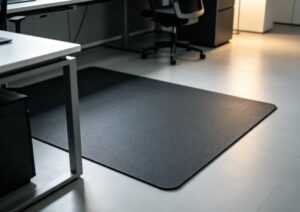
Anti Fatigue Mat Lifespan by Material: PVC, Rubber, Foam, and More
The material is one of the most important factors determining how long an anti fatigue mat can maintain its cushioning, durability, and ergonomic performance. Depending on the material structure and usage environment, lifespan can range from less than one year to more than ten years.
PVC sponge mats are among the most common and affordable options. Standard PVC sponge mats used under continuous pressure typically last around 1.5 to 3 years, while higher-quality PVC blends with improved density and structural stability can reach approximately 3 to 5 years. However, PVC has a higher risk of compression set compared with more resilient materials. Under heavy and continuous use, the cushioning may gradually decrease as the material loses its ability to recover after compression.
Rubber mats offer better resilience in demanding environments. Molded rubber mats commonly provide 1 to 3 years of service in high-intensity applications, while natural rubber and premium synthetic rubber products can last significantly longer when properly maintained. Their key advantage is superior elasticity and recovery performance, allowing them to maintain ergonomic support for extended periods.
Foam mats generally have shorter lifespans, especially when made from lower-density materials. Budget foam mats may lose their cushioning within 6 to 12 months, while mid-range PU foam mats typically last around 1 to 2 years. Because foam structures can permanently compress under continuous weight, their fatigue-reducing performance may decline faster over time.
Gel core mats provide excellent initial comfort but usually have a shorter functional lifespan. The gel layer can gradually lose its original support properties within 1 to 3 years, especially in areas exposed to repeated standing pressure.
For buyers selecting an anti fatigue mat, material choice should match the working environment. A PVC/PU anti fatigue mat with one-piece molded construction can provide a good balance of comfort, durability, and cost-effectiveness for commercial and residential applications, while heavy industrial environments may require higher-resilience rubber solutions.
Anti Fatigue Mat Lifespan by Material
| Τύπος υλικού | Τυπική διάρκεια ζωής | Compression Set Risk | Best Use Case |
|---|---|---|---|
| Cheap foam | 6–12 months | Very high | Light, occasional use |
| Mid-range PU foam | 1-2 χρόνια | High | Home offices, light commercial |
| Gel core | 1-3 χρόνια | Moderate-High | Kitchens, retail counters |
| PVC sponge (standard) | 1.5–3 years | Moderate (30–50% in 1 yr) | General commercial use |
| PVC sponge (premium) | 3-5 χρόνια | Μέτρια | High-traffic commercial |
| Molded rubber | 1-3 χρόνια | Low-Moderate | Industrial, workshops |
| Natural/SBR rubber | 5–10+ years | Low (20–35% in 12–18 mo) | Heavy industry, warehouses |
The product you’re looking at—made from PVC/PU with one-piece molding—sits in the PVC category. With premium construction and proper care, you can expect it to perform in the 3-to-5-year range under typical conditions. The one-piece molding design is particularly important: it eliminates delamination risks, meaning the mat won’t separate into layers over time.
How Usage Intensity Affects Anti Fatigue Mat Lifespan
Material determines the potential durability of an anti fatigue mat, but daily usage determines how quickly that performance is consumed.
An anti fatigue mat placed in a home office and used for two hours a day by one person will naturally last longer than the same mat installed at a factory workstation where employees stand on it for ten hours a day across multiple shifts.
For most quality anti fatigue mats, a typical service life ranges between 2 and 5 years, but actual lifespan depends heavily on standing hours, traffic frequency, cleaning requirements, and recovery time between uses.
- Light use (home offices, residential kitchens, low-traffic retail counters): 3–5 years is realistic. The mat experiences less continuous pressure and has more time to recover its original cushioning properties.
- Moderate use (commercial kitchens, clinic reception areas, light manufacturing areas): 2–4 years is common. More frequent standing, multiple users, and regular cleaning increase daily wear.
- Heavy use (industrial workstations, assembly lines, warehouse stations): 1–3 years for standard mats, while heavy-duty rubber models may extend performance to 5–8 years or longer.
The key point is that anti fatigue mat lifespan is not a fixed number. It depends on how much compression, movement, and environmental stress the material experiences every day.
Compression Set: Why Anti Fatigue Mats Lose Cushioning Over Time
The main reason an anti fatigue mat eventually loses effectiveness is not surface damage—it is the gradual loss of internal resilience.
Compression set refers to the permanent deformation that occurs when a material remains under pressure for extended periods. Every time someone stands on an anti fatigue mat, its internal cellular structure compresses. A high-quality material should recover after the load is removed, but repeated compression gradually reduces this recovery ability.
As compression set increases, the mat becomes flatter in high-use areas. The cushioning effect decreases, pressure distribution becomes less effective, and the ergonomic benefits designed to reduce standing fatigue begin to disappear.
This is why the softest mat is not always the most durable choice. A very soft mat may provide excellent comfort at first but lose its cushioning faster if the material has poor compression recovery. A slightly firmer anti fatigue mat with better resilience may maintain ergonomic performance much longer.
Professional testing evaluates this performance by measuring changes in thickness and recovery after repeated loading. Once a mat loses too much of its original thickness and resilience, it can no longer provide the same level of support and fatigue reduction.
Environment: What’s Under and Around the Mat
Where you place your anti fatigue mat matters almost as much as what it’s made of.
Temperature extremes are brutal on mat materials. PVC mats, in particular, are notorious for rippling, cracking, and curling at the edges when exposed to temperature fluctuations. A mat near a hot oven or in an unheated garage will degrade faster than one in a climate-controlled space.
Moisture is another enemy. Mats that sit in wet areas or aren’t dried properly after cleaning can develop mildew or degrade at the edges. Rubber and PVC-based mats are more resilient to moisture than foam, but no mat benefits from standing water.
Dirt and grit act as abrasives. When debris gets trapped between the mat and the floor—or ground into the mat’s surface—it accelerates wear. This is why entrance mats that trap dirt before it reaches your anti fatigue mat can significantly extend the mat’s life.
UV exposure from direct sunlight causes fading and can break down the material’s molecular structure over time. If your mat is near a window, consider rotating it periodically or using window treatments to limit direct sun exposure.
The Seven Signs Your Anti Fatigue Mat Needs Replacing
You don’t need a calendar to know when to replace your anti fatigue mat. Your body—and your eyes—will tell you.
- You can feel the floor through the mat. This is the most obvious sign. If you can feel the hardness of the underlying floor through the cushioning, the mat has lost its ergonomic function.
- Permanent indentations remain where people stand. Step off the mat and look at it. Are there visible depressions where feet have been? That’s compression set. Once those depressions form, the mat isn’t bouncing back—and it’s not providing consistent support.
- The edges are curling or chipped. Curled edges aren’t just unsightly—they’re a trip hazard. Worn or chipped edges can cause employees or family members to stumble.
- The mat slips on the floor. Anti fatigue mats are supposed to stay put. If yours is sliding around, the backing has lost its grip. A slipping mat is a safety hazard.
- Cracks are visible on the surface or underside. Cracks indicate material fatigue. Once cracking starts, it will spread, and the mat will eventually break apart.
- The mat is difficult to clean. As the surface breaks down, dirt and grime embed themselves in the material. If you can’t get your mat clean anymore, it’s past its prime.
- Visible fading has occurred. Fading doesn’t necessarily mean the mat has lost its function, but it’s a clear sign that the material is degrading. Combined with other signs, fading confirms it’s time for a replacement.
When to Replace Your Anti Fatigue Mat
| Sign of Wear | What It Means | Action |
|---|---|---|
| Can feel floor through mat | Compression set has eliminated cushioning | Replace immediately |
| Permanent indentations | Material no longer recovers | Replace within 1–2 months |
| Curled or chipped edges | Structural integrity compromised | Replace—trip hazard |
| Mat slips on floor | Backing grip is gone | Replace immediately—safety risk |
| Visible cracks | Material fatigue | Replace within 1 month |
| Surface won’t clean | Material breakdown | Replace |
| Visible fading | Material degradation | Monitor; replace if other signs appear |
How to Make Your Anti Fatigue Mat Last Longer
A good anti fatigue mat is an investment. Here’s how to protect that investment.
Clean it regularly. Proactive cleaning can extend a mat’s useful life by up to an entire year. Sweep or vacuum daily to remove abrasive dirt and grit. For deeper cleaning, use a mild detergent solution and a soft brush—avoid bleach and harsh chemicals that can damage the material.
Rotate the mat periodically. If your mat sees uneven traffic—and most do—rotate it 180 degrees every few months. This distributes wear across the entire surface rather than concentrating it in the most-trafficked areas.
Don’t leave heavy equipment on it. A chair, a pallet, or a piece of equipment left on the mat for hours or days will create permanent compression set. If you need to store something heavy on the mat temporarily, place a piece of plywood under it to distribute the weight.
Clean underneath the mat. Dirt and debris trapped between the mat and the floor create uneven pressure points and can cause premature wear. Lift the mat and sweep underneath regularly.
Address spills immediately. Liquids can seep into the material and cause degradation over time. Wipe spills as soon as they happen using a damp microfiber cloth.
Avoid excessive heat. Don’t wash mats in water above 140°F—hot water can damage the material structure. And never place a mat near a heat source that could soften or deform it.
Συμπέρασμα
An anti fatigue mat is more than a comfort accessory—it is a long-term investment in workplace safety, productivity, and user comfort. The lifespan of a mat depends mainly on its material, construction quality, working environment, and maintenance.
For home offices and light commercial use, a quality PVC/PU anti fatigue mat can typically provide 3–5 years of reliable performance. For demanding industrial applications, heavy-duty rubber mats may offer a longer service life with better resistance to compression and wear.
When selecting a durable anti fatigue mat, focus on more than the initial cost. Evaluate material performance, structural design, and expected anti fatigue mat lifespan based on your specific application.
Ready to choose a long-lasting anti fatigue mat for your workspace? Select a supplier that provides reliable materials, consistent quality control, and solutions designed for real working conditions. The right mat delivers lasting comfort, safety, and value over time.
