
Introduction
Do you fall asleep on your back but wake up on your side? Or keep switching positions through the night, trying to find comfort?
Most pillows are designed for a single sleep position. For combination sleepers, this often means constant discomfort—what works for back sleeping fails when you turn sideways, and vice versa.
The Memory Foam Butterfly Pillow solves this with a dual-zone design: raised wings for side sleeping and a recessed centre for back sleeping, offering support without adjustment.
This article explains how the Memory Foam Butterfly Pillow works, how it differs from traditional and contour pillows, and why combination sleepers are switching to it.
The Anatomy of a Butterfly Pillow: Dual-Zone Design
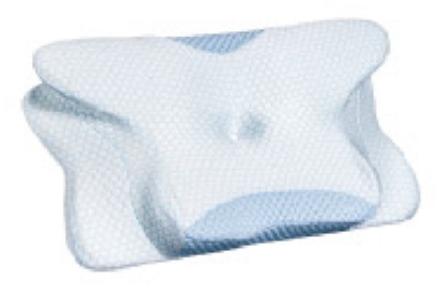
The Memory Foam Butterfly Pillow gets its name from its shape: two raised side wings flank a recessed centre channel, resembling open butterfly wings. But this design is functional, not decorative.
At its core, the pillow uses a zoned support system. It has:
- A central head cradle (recessed centre)
- Elevated side wings for side sleeping
- Shoulder transition areas
- Hand rest spaces
This multi-zone layout ensures your head and neck are supported in different positions automatically. Chinese design patents confirm the same principle: your head rests in the centre when on your back and on the wing when on your side. Unlike traditional pillows, you don’t need to adjust it—your natural movement lands you in the correct zone.
Trade-off: the fixed shape isn’t adjustable. If the wing height or centre depth doesn’t match your body, the fit may feel off.
How the Butterfly Pillow Supports Back Sleepers
For back sleepers, the pillow must fill the gap between the neck and mattress without pushing the head too far forward. The cervical spine has a natural forward curve (lordosis), which pillows can help maintain.
The recessed centre channel of the Memory Foam Butterfly Pillow cradles the head while slightly raised edges support the sides of the neck, keeping cervical alignment neutral. Some models feature a subtle forward tilt (~10°) to mimic natural spine alignment and reduce morning stiffness.
The centre recess also offers anti-slip stability, keeping your head in place through the night. However, centre depth varies between models—too deep feels like sinking, too shallow reduces support. Individual anatomy matters. Overall, a Memory Foam Butterfly Pillow provides back sleepers with consistent support night after night.
How the Butterfly Pillow Supports Side Sleepers
Side sleeping requires proper head elevation to keep the spine horizontal. Too low, and your head droops; too high, and your spine kinks.
The raised wings of the Memory Foam Butterfly Pillow fill the shoulder gap, supporting the head at a neutral height. Typical wing heights range 8–12 cm; for example, Nantong Hengjia’s model is 8 cm, suitable for smaller frames or lower loft preferences.
Some pillows offer dual-height designs, letting users flip the pillow 180°: lower loft for back sleeping or petite users, higher loft for taller or side sleepers.
Wing shape matters: a subtle outward flare accommodates shoulder angle and reduces pressure. Extended side zones provide hand rest spaces, preventing arm numbness—a small but meaningful comfort improvement that standard pillows often miss. Using a Memory Foam Butterfly Pillow can make side sleeping noticeably more comfortable.
The Material Advantage: Why Memory Foam Makes the Butterfly Design Work
A well-designed shape means little without the right material. The Memory Foam Butterfly Pillow works because memory foam enables its dual-zone structure.
Memory foam (viscoelastic polyurethane foam) has two key properties: slow rebound and pressure distribution. When you lie on it, the material softens with body heat, molds to your head and neck, and slowly returns to shape when you move. This allows the Memory Foam Butterfly Pillow to adapt to both back and side sleeping without any manual adjustment.
Equally important is pressure relief. Unlike standard pillows that create pressure points, memory foam spreads weight evenly, reducing local stress on the head and cervical spine. This is especially beneficial for side sleepers, who place more weight on a smaller area than back sleepers do.
Heat retention is a known drawback of traditional memory foam. However, modern designs reduce this issue through open-cell structures, perforation patterns, and breathable covers. Tencel fabric is commonly used because it improves moisture wicking and feels smoother against the skin.
For example, the Nantong Hengjia butterfly pillow uses a Tencel sandwich mesh cover that enhances airflow, reduces heat buildup, and lowers friction against skin and hair for added comfort.
Comparison: Butterfly Pillow vs. Traditional vs. Contour
To understand where the Memory Foam Butterfly Pillow fits in the pillow landscape, it helps to compare it directly against the alternatives.
| Feature | Memory Foam Butterfly Pillow | Traditional Rectangular Pillow | Standard Contour Pillow |
|---|---|---|---|
| Core design principle | Zoned support with raised wings + recessed centre | Uniform thickness across the entire surface | Graduated wave (high on one side, low on the other) |
| Support for back sleepers | Recessed centre keeps head neutral, slight forward cervical angle | Depends on the loft; often either too high or too low | The low side provides cervical support if oriented correctly |
| Support for side sleepers | Raised wings fill the shoulder gap; dedicated arm space | May require folding or stacking to achieve the correct height | High side provides support, but no dedicated shoulder transition |
| Support for combination sleepers (back ↔ side) | Excellent—natural roll transition between zones | Poor—requires repositioning or adjusting | Good—can flip between high and low sides |
| Pressure distribution | High (memory foam + zoning) | Low–Moderate | Moderate–High |
| Cervical alignment claim | Built into shape (10° curve common) | None—depends on fill material and loft | Built into the wave profile |
| Adjustment flexibility | Low (fixed shape) | High (can bunch, fold, or add fill) | Moderate (can flip orientation) |
| Best for | Combination back-side sleepers with medium frames | Sleepers who prefer a single fixed position | Back sleepers or those with specific cervical needs |
| Less ideal for | Stomach sleepers, very broad/narrow shoulders, CPAP users without testing | Combination sleepers, people with neck pain | Side sleepers who need arm clearance |
| Typical material | Memory foam (viscoelastic) | Polyester, down, feather, cotton | Memory foam, latex |
Feature comparisons are drawn from manufacturer specifications and product descriptions.
One crucial difference worth highlighting: traditional pillows provide uniform support across the entire surface—they don’t adapt to different sleeping positions. A contour pillow offers two distinct heights (a low side for back sleeping and a high side for side sleeping), but you have to flip it intentionally when you change positions. The Memory Foam Butterfly Pillow‘s design places both supports within the same orientation, allowing natural rolling motion rather than deliberate adjustment.
That said, contour pillows have a longer track record of clinical research. Systematic reviews have found moderate evidence that contoured pillows containing memory foam can improve sleep quality and spinal alignment and reduce sleep-related neck pain. Butterfly pillows are a newer variation on this concept, and direct comparative research is more limited.
Beyond Sleep Position: Unexpected Benefits of the Butterfly Pillow
The dual-position support is the headline feature. But users and manufacturers report several additional benefits worth noting.
Reduced morning neck stiffness. People with chronic neck tension often find relief from the centre channel, which holds the head in a neutral position and prevents the lateral tilting that occurs on flat pillows. The cervical support is built into the shape rather than relying on pillow firmness alone, which means consistent support regardless of how much the foam softens overnight.
Less snoring. For some people, snoring is exacerbated by poor head and neck positioning that narrows the airway. Maintaining a neutral cervical alignment—rather than allowing the chin to drop toward the chest—can help keep the airway open. While butterfly pillows aren’t marketed as anti-snoring devices specifically, back sleepers who snore may notice an improvement when using the centre channel as intended.
CPAP compatibility. Some CPAP users prefer butterfly pillows because the recessed side areas create space for the mask without pressing it into the face. The side lobes hold the head above the cutout rather than compressing the mask against the cheek. However, this depends heavily on mask style; some masks sit exactly where the butterfly wing intersects the face, making the pillow unsuitable for that particular design.
Reduced facial pressure and sleep wrinkles. Side sleeping naturally compresses the face against the pillow, which can contribute to sleep lines and, over time, asymmetrical facial wrinkles. The extended side zones on some butterfly pillows distribute this pressure more evenly, reducing the concentrated force on the cheek and eye area. The smooth Tencel covers also create less friction against the skin than cotton or polyester.
Arm numbness prevention. Anyone who has woken up with a dead arm after sleeping on their side knows the discomfort. The hand rest spaces built into butterfly pillows give your lower arm a place to rest without bearing the full weight of your head and shoulder. This is a small design detail that makes a meaningful difference in sleep quality.
Who Should (and Shouldn’t) Use a Memory Foam Butterfly Pillow
The butterfly pillow is not a universal solution. Knowing when it’s the right choice—and when it isn’t—saves you time and money.
The ideal candidate for a Memory Foam Butterfly Pillow is the combination sleeper who regularly shifts between back and side positions during the night. If you fall asleep on your side and wake up on your back, or if you consciously alternate between the two, the contoured zones provide appropriate support for each position without requiring you to adjust the pillow. A standard rectangular pillow, by contrast, is a compromise for every position.
The sweet spot also extends to body dimensions. If your shoulder width is average for your height and the pillow’s wing height aligns with your shoulder-to-neck distance, the fit will feel natural. If you have very broad shoulders or a particularly slender frame, the fixed wing height may not match your needs, and there’s no way to adjust it.
Now, who should skip the butterfly pillow?
Dedicated stomach sleepers. The raised centre channel and wings create too much height under the face, forcing the neck into an extremely rotated position. Stomach sleepers are better served by very thin, flat pillows or no pillow at all.
Exclusive side sleepers who need more loft than the wings provide. If you require a 12 cm+ pillow height for proper spinal alignment on your side, most butterfly pillows won’t reach that level. Their wing heights typically max out around 10–11 cm.
People who move frequently end up sideways across the pillow. The butterfly shape is designed for specific positioning. If you rotate 90° during sleep, the zones won’t align with your body.
Individuals with significant cervical spine issues. If you have diagnosed cervical conditions, a customised or clinically recommended pillow is a better choice than a fixed-shape butterfly pillow. The butterfly shape cannot be adjusted for your specific needs, whereas some cervical pillows offer adjustable fill layers or custom-moulded designs.
Those who sleep very hot. Memory foam retains more heat than latex, down, or synthetic fibre pillows. Even with improved breathability features, hot sleepers may find the temperature regulation insufficient compared to other materials.
Real-World User Scenarios: When the Butterfly Pillow Shines
Sometimes, concrete examples communicate better than technical explanations. Here are three scenarios where a Memory Foam Butterfly Pillow makes a genuine difference.
Scenario 1: The restless side-to-back switcher
Sarah works long hours at a desk and carries tension in her neck. She falls asleep on her side but wakes up on her back most nights. With her old pillow, she’d wake up with a stiff neck because the pillow didn’t support her properly in either position. Switching to a butterfly pillow gave her a consistent support surface regardless of her sleep position. The centre channel cradles her neck when she’s on her back; the wing cradles her head when she’s on her side. She no longer wakes up reaching for pain relief.
Scenario 2: The arm-numbness sufferer
Mike is a dedicated side sleeper who constantly woke up with his lower arm completely dead. He assumed it was a circulation issue. In reality, his arm was bearing the weight of his head and shoulder against a pillow that offered no relief. The hand rest zone on a butterfly pillow gave his arm somewhere to go, eliminating the nightly numbness almost immediately.
Scenario 3: The CPAP user finds mask compatibility
Linda uses a nasal pillows CPAP mask. Traditional pillows pressed the frame into her cheek when she slept on her side, causing leaks and skin irritation. The recessed side area on a butterfly pillow created enough clearance that the mask sat comfortably without being compressed against the pillow surface. Not every CPAP user will have this experience—mask styles vary significantly—but for Linda, the butterfly pillow was a game-changer.
Scenario 4: The hot sleeper upgrading to breathable materials
David runs warm at night and avoided memory foam for years because of its heat retention reputation. The Tencel cover and improved foam perforation on modern butterfly pillows changed his mind. He now uses one regularly without overheating, noting that the improved airflow and moisture-wicking fabric keep his head cooler than his old cotton pillow ever did.
Selection Guide: What to Look for in a Quality Memory Foam Butterfly Pillow
If you’re convinced that a Memory Foam Butterfly Pillow might work for you, here’s what to evaluate before buying.
1. Wing height and loft options.
Measure your shoulder width or compare product dimensions against your body size. Some pillows offer dual-height designs that let you flip the pillow to choose between two lofts. If you’re over 5’5″ or broad-shouldered, look for higher wings (3.9″+). If you’re petite or prefer back sleeping, lower wings (3.1″ or less) may suit you better.
2. Centre channel depth.
The recess should be pronounced enough to stabilise your head but not so deep that you feel like you’re falling into a hole. If possible, read user reviews from people with similar head/neck proportions to yours.
3. Foam density and certification.
Higher-density memory foam (typically 40–60 kg/m³) offers better durability and support than low-density foam. Look for OEKO-TEX Standard 100 certification to ensure the foam is free from harmful substances.
4. Cover material.
Tencel (lyocell) covers offer excellent moisture-wicking and a smooth, cool feel. Cotton covers are breathable and familiar but may not wick as effectively. Avoid polyester-only covers if you sleep warm.
5. Return policy.
Because the fixed shape of a butterfly pillow either fits you or doesn’t, a generous return window (30 days or more) is essential. Don’t commit to a pillow you can’t test overnight.
6. Cooling features.
Open-cell foam, gel infusions, perforation patterns, and phase-change materials all improve breathability. If you’re a warm sleeper, prioritise these features even if they increase the price.
The Nantong Hengjia Memory Foam Butterfly Pillow, for example, offers a standard 61 × 36 × 8 cm size with a Tencel blue sandwich mesh cover and memory foam construction. At 1,200g, it’s relatively lightweight and suitable for a range of users, though its single 8 cm height means it won’t accommodate both very low and very high loft preferences in the same pillow.
Conclusion: Does the Butterfly Pillow Deliver on Its Promise?
For the right sleeper, absolutely.
The Memory Foam Butterfly Pillow solves a real problem that standard pillows ignore. If you sleep on both your side and your back during the night, you don’t need two pillows—you need one pillow with two different support zones. The butterfly shape delivers exactly that: raised wings for side sleeping, a recessed centre for back sleeping, and thoughtful details like hand rest spaces and shoulder transitions that improve comfort in ways you don’t notice until you experience them.
That said, the Memory Foam Butterfly Pillow is not a one-size-fits-all solution. Its fixed dimensions mean it works beautifully for people whose body proportions align with its design and poorly for those whose proportions don’t. Stomach sleepers, very broad or very narrow individuals, and people with significant cervical spine issues should look elsewhere.
But for the millions of combination sleepers who wake up with neck stiffness, numb arms, or general discomfort from a pillow that can’t keep up with their nighttime movements, the butterfly pillow offers a legitimate upgrade. It’s one of the few pillow designs that acknowledges how people actually sleep—not how manufacturers wish they would sleep.
The best way to find out if it works for you? Try one with a solid return policy. Your neck will let you know within a few nights.
Ready to experience the difference for yourself? Nantong Hengjia Home Technology Co., Ltd. offers a Memory Foam Butterfly Pillow with Tencel cover and ergonomic cervical support. Request specifications and pricing here.
