
High rebound sponge has become one of those materials that quietly supports a massive range of modern products—yet most people have never considered how deeply engineered it actually is. The material looks simple, feels familiar, and compresses under your hand just like any foam. But the reason it snaps back instantly, maintains elasticity after thousands of stress cycles, and survives wildly different environments has everything to do with polymer science, molecular crosslinking, and multi-stage manufacturing that evolved alongside material technologies.
The Physics Behind High Rebound Sponge
The high rebound effect isn’t magic, nor is it simply “soft equals good.” The feel originates from a dance between polymer chains, network crosslinks, and the geometry of the cell structure.
Molecular Structure: Why It Springs Back So Fast
All polyurethane-based foams that have a high rebound are composed of long chains of polymer that are connected by cross-links. However, in high rebound formulas, the crosslink density is altered to facilitate rapid recovery while avoiding collapse.
When the foam is compressed, its molecular chains appear to deform like coil springs.
When they are let out, they travel back along the energy pathways embedded in the polymeric network.
In a common sponge, those links dilute over time. In the high rebound sponge, the energy is almost immediately regained—what you feel as the signature bounce.
Internal Cell Geometry: The Architecture Within
Take a microscopic look at a high rebound sponge, and you’ll see a labyrinth of open cells resembling tiny, fused bubbles.
The geometry—size, thickness, openness—is not random.
It is engineered to:
• allow air to escape rapidly during compression
• allow air to rush back in during rebound
• prevent permanent collapse after repeated loads
This airflow behavior is why high rebound sponge feels alive compared to regular foam, which tends to “sink and stay” before slowly recovering shape.
How the Manufacturing Process Shapes Performance
High rebound sponge performance is not only determined by chemistry; it’s equally influenced by the production line. Small changes in any step—mixing, foaming, curing, cutting—can change rebound behavior dramatically.
Polyol and Isocyanate Ratios
The foundational ingredients of polyurethane foams are polyols and isocyanates. In high rebound sponge manufacturing, the ratio between them determines:
• elasticity
• rebound speed
• compression set
• tensile resilience
• temperature stability
Manufacturers often adjust the formula depending on the final application—insoles, mattress cores, packaging shock absorbers, or upholstered furniture.
Controlled Foaming and Rise Time
The “rise” of the foam—the moment it expands from liquid to a fully formed sponge—is where most of its physical structure is defined.
A high rebound production line uses controlled foaming conditions to create:
• uniform pore sizes
• balanced cell walls
• stable open-cell connectivity
This influences not only elasticity, but also softness, gas flow, and acoustic or thermal performance.
Key factors a factory manipulates during foaming:
• Ambient temperature & humidity: affects reaction speed and pore opening
• Surfactant type: determines cell uniformity
• Catalyst concentration: accelerates or slows polymer chain formation
• Blowing agent levels: controls pore size and density
Small tweaks can dramatically shift the rebound curve—one reason why high rebound sponge requires stricter process control than ordinary foam.
Different Grades of High Rebound Sponge: Not All Bounce Is Equal
Consumers often assume all “high rebound” foams are the same. In reality, rebound behavior varies significantly depending on industry requirements.
Footwear-Grade High Rebound Sponge
Shoes demand foams with fast rebound but also long fatigue life. Footwear-grade sponge is engineered for:
• high cushioning
• impact dissipation
• resistance to repeated compression cycles
Athletic footwear in particular uses rebound rates measured in milliseconds.
Furniture-Grade High Rebound Sponge
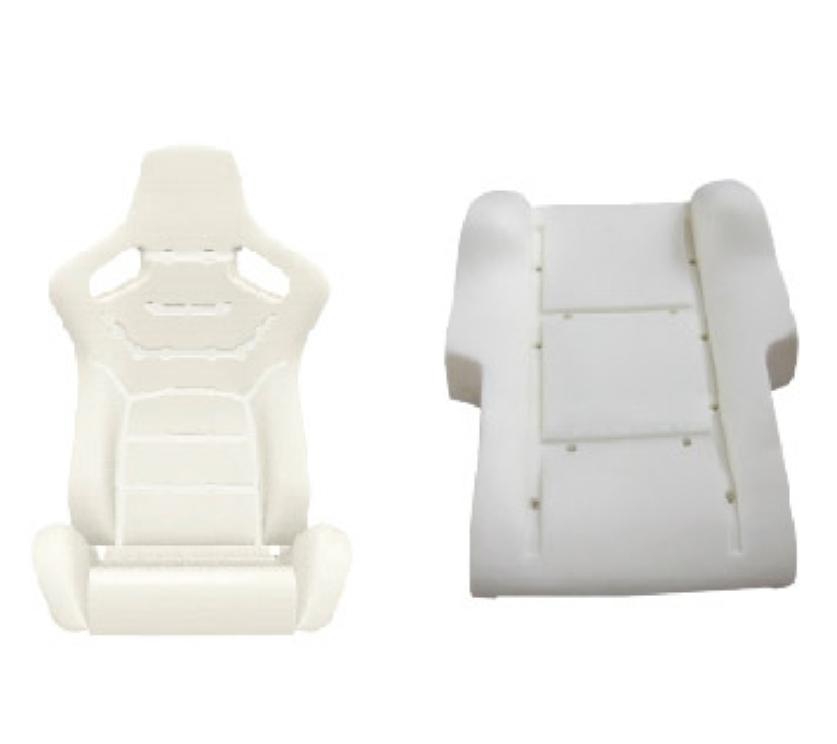
Here, the priority shifts. Sofas and chairs need:
• consistent support over years
• thicker foams with slower initial rebound
• higher load-bearing capability
The result is a firmer but equally springy feel.
Industrial-Grade High Rebound Sponge
Factories use high rebound sponge for shock absorption, sealing, anti-collision padding, and vibration control.
It must be:
• resistant to oils
• thermally stable
• non-crumbling under continuous mechanical stress
The rebound rate is only a small part of the performance package.
• Footwear: ultra-fast rebound < 200ms
• Mattresses: medium rebound 300–600ms
• Packaging & shock absorption: wider tolerance depending on load
• Automotive: heat-stable rebound under 80–120°C
• Furniture: balanced rebound with higher density requirements
This demonstrates how “high rebound” is not a single material but a family of engineered behaviors.
Why Long-Term Performance Matters More Than Initial Softness
The real measure of a high rebound sponge is not how soft it is on Day 1, but how it behaves on Day 1000.
Compression Set: The Silent Killer of Cheap Foam
Compression set is the percentage of thickness a foam permanently loses after being compressed for long periods.
High rebound sponge maintains exceptionally low compression set under:
• continuous load
• repeated flexing
• high temperatures
• humid environments
A cheap sponge may feel soft initially, but collapses within months.
The “Memory Path” Effect
High rebound sponge develops a “behavioral curve” over time, meaning that the more it cycles through compression, the more consistent its rebound becomes.
Regular foam, by contrast, becomes irregular, stiff in some regions, and collapsed in others.
• Low permanent deformation even after 10,000 cycles
• Even rebound distribution—no dead zones
• Stable elasticity in hot or cold environments
• Uniform pore structure when sliced
These are the criteria factories, not consumers, use to judge quality.
Why Modern Product Design Relies on High Rebound Sponge
High rebound sponge has quietly become essential in many modern designs. The rise of ergonomic products, shock-absorbing packaging, high-performance athletic gear, and comfort-centric furniture all depend on the material’s properties.
Ergonomic Pressure Distribution
Unlike memory foam—which slowly molds and slowly recovers—high rebound sponge spreads force quickly and evenly. That makes it ideal for:
• seat cushions
• office chairs
• wheelchair pads
• automotive interiors
It supports without creating “sinkholes.”
Shock Absorption for Motion and Impact
In footwear, sports gear, helmets, and tool handles, high rebound sponge:
• absorbs kinetic energy
• returns part of the energy as forward motion
• reduces fatigue over long use
This is why it’s used in performance footwear midsoles and athletic protective equipment.
Durability in High-Cycle Environments
Many industries choose high rebound sponge not for softness, but because it withstands:
• repeated bending
• vibration
• compression
• torsion
This makes it ideal for industrial pads, protective inserts, machine component cushioning, and automotive noise reduction systems.
The Future of High Rebound Foam: Green Chemistry and Smart Materials
The next evolution of high rebound sponge is being shaped by environmental expectations and intelligent manufacturing.
Bio-Based Polyols
Manufacturers are increasingly adopting polyols derived from:
• castor oil
• soy
• sugarcane
• recycled PU feedstock
These reduce carbon footprint without compromising rebound performance.
3D-Controlled Foaming with AI Monitoring
Future production lines will use machine vision and closed-loop AI adjustment to monitor:
• cell formation
• density changes
• reaction uniformity
This allows precise tailoring of rebound curves for different industries.
Hybrid High Rebound Sponge
Material scientists are already creating hybrid foams that combine:
• high rebound core
• slow-rebound outer layer
• breathable channels
• anti-microbial additives
Such materials will define next-generation footwear, bedding, and ergonomic furniture.
High Rebound Sponge as Engineered Performance Material
The high rebound sponge is more than a soft cushioning component. The behavior of its rebounds, endurance, structural design, and advanced manufacturing makes it a highly intended component that is integral to footwear, furniture, automotive, packaging, sports, and other fields.
Understanding the way polymeric networks store and release energy, the way manufacturing affects cell structure, and the way industries define “ideal” rebound allows us to appreciate the material in its entire technical complexity.
The popularity of the high rebound sponge isn’t solely due to its comfort, it is also based on chemistry, physics, and engineering.
